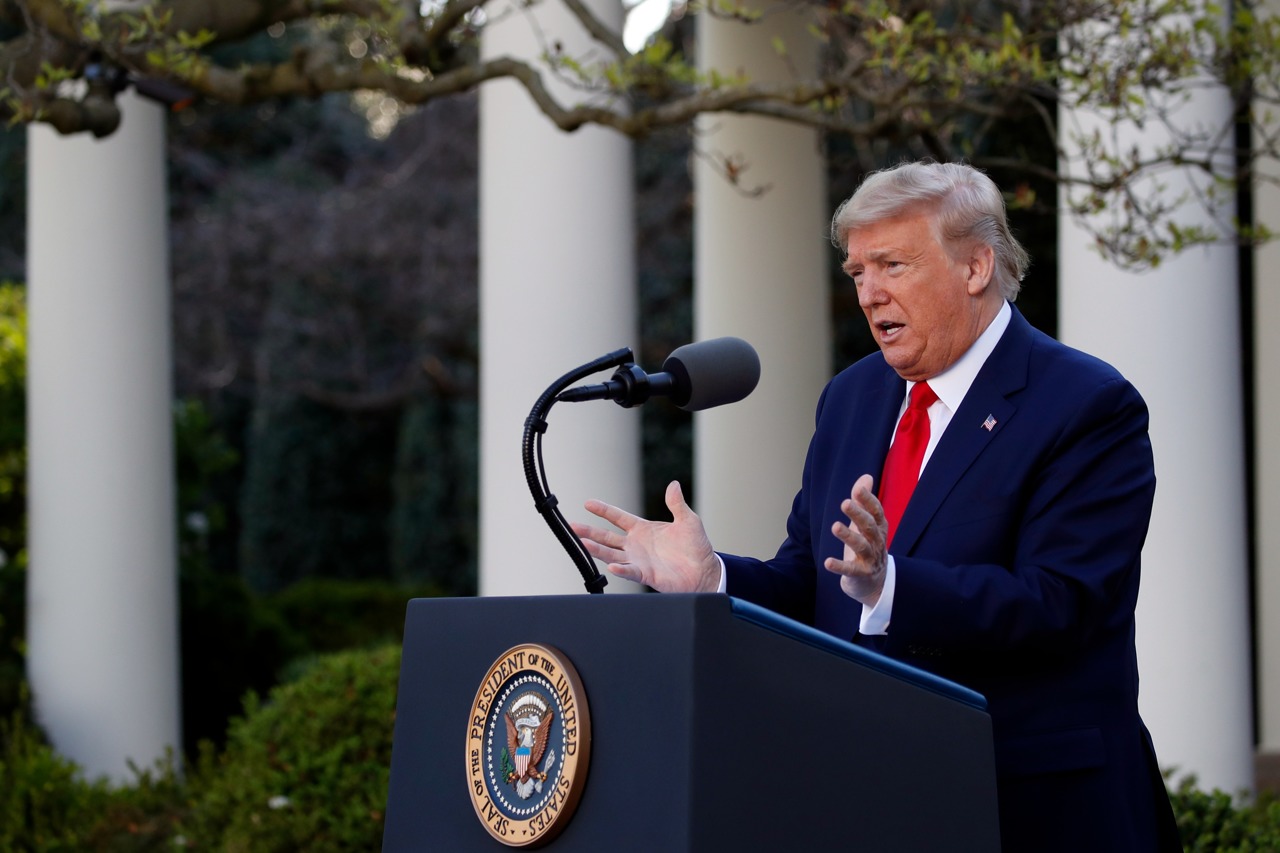
"From the start of the coronavirus outbreak, statements from the presidential pulpit have been far out of step with those of health experts and many inside the administration. President Trump contradicted some officials while they were standing right next to him. Here is a sampling of what Mr. Trump has said compared with statements made by prominent officials." By Linda Qiu, Bill Marsh and Jon Huang March 18, 2020.
Jan 22: In late January, President Trump expressed optimism. “We have it totally under control. It’s one person coming in from China, and we have it under control. It’s going to be just fine,” he said on CNBC.
Feb 2: With fewer than a dozen cases reported, Mr. Trump said in an appearance with Sean Hannity that the United States had stopped the virus’s spread by restricting travel. “We pretty much shut it down coming in from China,” he said.
Feb 14: Mr. Trump told the National Border Patrol Council not to worry. “There’s a theory that, in April, when it gets warm — historically, that has been able to kill the virus.” (W.H.O. later said, “We have no reason to believe that this virus would behave differently in different temperatures.”)
Feb 26: Even as the number of cases rose to 60, Mr. Trump said at a news conference that infections were declining. “We’re going down, not up. We’re going very substantially down, not up.” He continued, “As they get better, we take them off the list, so that we’re going to be pretty soon at only five people. And we could be at just one or two people over the next short period of time.”
Feb 27: At the White House the next day, Mr. Trump offered a mixed message on the outbreak’s trajectory. “It’s going to disappear. One day — it’s like a miracle — it will disappear. And from our shores, we — you know, it could get worse before it gets better. It could maybe go away. We’ll see what happens. Nobody really knows.”
Feb 28: At a rally in South Carolina, Mr. Trump said that Democrats had been “politicizing” his response to the coronavirus, just as he said they had the Russia investigation and the impeachment inquiry. “They tried anything, they tried it over and over,” he said. “And this is their new hoax.” Later, he accused the news media of being in “hysteria mode” over the coronavirus, which he suggested was unwarranted.
March 2: When U.S. cases surpassed 100, Mr. Trump assured attendees at a rally in Charlotte, N.C., that a vaccine was on the way. “We had a great meeting today with a lot of the great companies, and they’re going to have vaccines, I think, relatively soon,” he said.
March 4: Mr. Trump told Mr. Hannity that he had a hunch the fatality rate was lower. “Well, I think the 3.4 percent is really a false number. Now, and this is just my hunch, and, but based on a lot of conversations with a lot of people that do this, because a lot people will have this and it’s very mild.” He continued, “I think the number, personally, I would say the number is way under 1 percent.”
March 6: Mr. Trump insisted, “Anybody that needs a test can have a test.”
March 7: With nearly every state reporting at least one case, a reporter asked Mr. Trump whether he was concerned that the virus was getting closer to the White House. Mr. Trump replied, “No, I’m not concerned at all. No, I’m not. No, we’ve done a great job.”
March 15: On Sunday, as the U.S. passed 3,000 cases, Mr. Trump said the situation was under control. “This is a very contagious virus. It’s incredible. But it’s something we have tremendous control of.”
March 17: By Tuesday, Mr. Trump’s message had shifted completely from January. “I’ve always known this is a real — this is a pandemic,” he said. “I felt it was a pandemic long before it was called a pandemic.”
很显然,总统真的在wait and see, å¯èƒ½ç¡ç€äº†ç‰ï¼Ÿè¦ä¸ç„¶ï¼Œæ€Žä¹ˆçŽ°åœ¨å·²ç»164,719 个确诊了???